How to Choose a Concrete and Pressure Washing Company in NJ
Choosing a concrete and pressure washing company in NJ? The surface-type, insurance, and runoff checks a cheap crew skips and the property owner inherits.
To choose a concrete and pressure washing company in NJ, check three things before price: that they match pressure to your surface, that their insurance covers exterior pressure work, and that they contain the wash-water runoff. The same 4,000 PSI that cleans a loading dock will etch a polished floor in one pass.
Most facility managers vet a pressure washing company the way they vet an interior cleaner: insurance, a price per square foot, and a start date. That misses the two things that actually go wrong on concrete, which are the wrong machine on the wrong surface and the wash water going down a storm drain. This is the vetting checklist we would hand a property manager before they sign anyone, including us.
Updated October 2026.
Is All Concrete the Same Under a Pressure Washer?
No. Sealed, unsealed, polished, and epoxy-coated concrete each fail differently under the same machine, and that surface-type distinction is the part almost no pressure washing sales pitch mentions. A crew that shows up with one wand setting and runs it across your whole property will clean the unsealed sidewalk beautifully and quietly wreck the polished lobby floor on the next pass.
The tell of a real contractor is simple. During the walkthrough, do they name your surfaces, or do they just measure square footage? Here is the same job broken out by surface, which is the conversation you want them starting:
| Surface | What it is | Right method | Wrong-machine failure | |---------|-----------|--------------|-----------------------| | Unsealed concrete | Raw sidewalks, docks, dumpster pads | High pressure, 3,000 to 4,000 PSI through a surface cleaner | Almost none, this is what high pressure is for | | Sealed concrete | Topical film sealer over concrete | Soft wash, low pressure plus detergent | High pressure lifts the sealer and leaves it blotchy | | Polished concrete | Ground and densified interior floor | Low-moisture or soft wash, surface-safe pads | A fan tip hazes and streaks the polish in one pass | | Epoxy-coated | Warehouse and garage floor coatings | Low pressure, controlled temperature | Delamination at seams and edges, water under the coating |
If the company cannot tell you which of these four you have and what changes for each, they are guessing with your property. That single question separates a contractor from a guy with a machine.
Is More Pressure Always the Answer?
No, and "we use commercial-grade high pressure" is a warning, not a selling point. PSI is only half the spec, and on most concrete it is the less important half. Water volume, measured in gallons per minute, does the actual rinsing, and heat does the degreasing. A crew that leans on raw pressure to compensate for low flow and cold water is the crew most likely to etch your surface.
Ask what tools they bring and why:
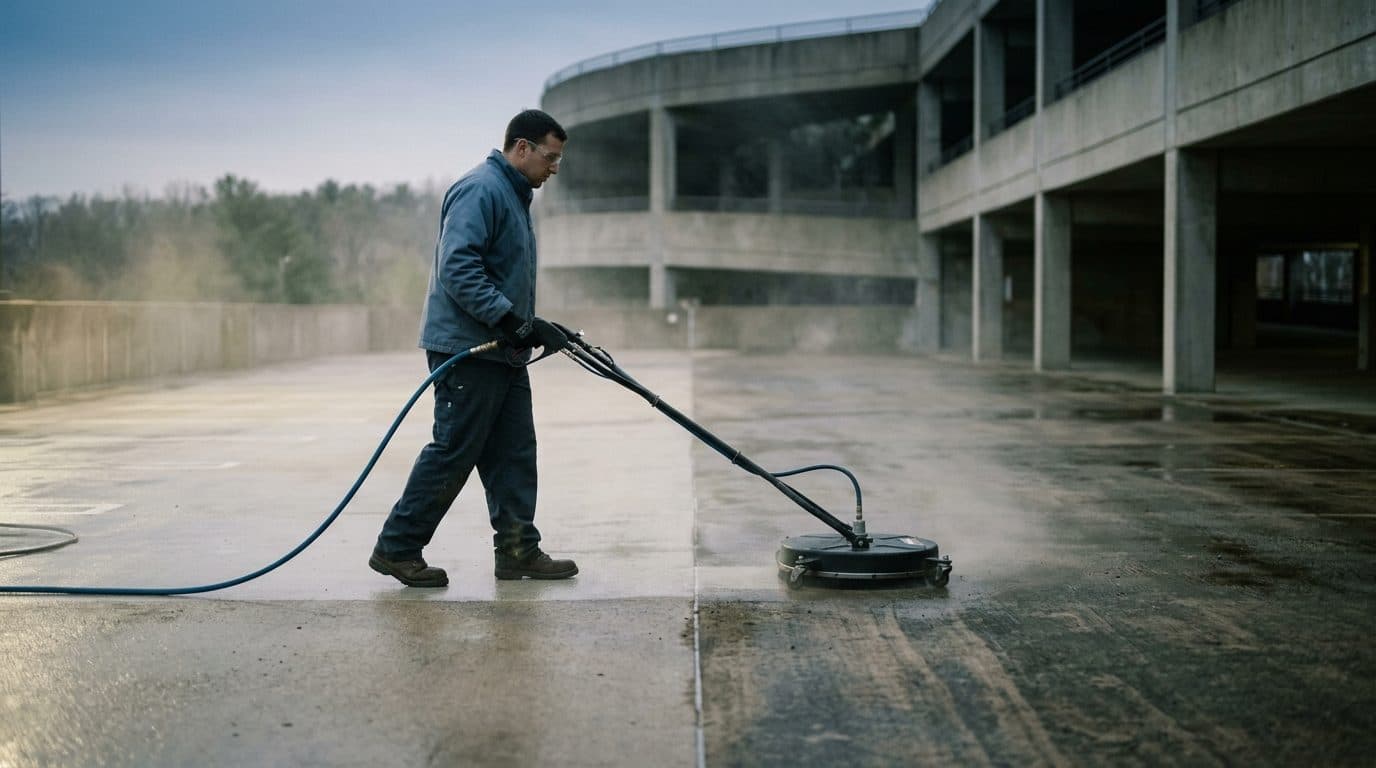
- A surface cleaner, the flat rotating disc, for open concrete. It delivers even coverage and prevents the zebra-striping you get from a wand swung by hand.
- Hot water capability for oil, grease, and gum on docks and drive lanes. Cold water at high pressure just pushes grease around.
- Soft washing for anything sealed, painted, or coated, and for building facades. This is low pressure plus a cleaning agent doing the work chemically instead of mechanically.
- Adjustable tips and a test pass. A professional tests an inconspicuous spot and dials the setting to the surface before committing to a full run.
A company that answers "we just turn up the pressure until it is clean" is telling you they will find the failure point on your floor, not in a test corner.
Do Parking Decks, Docks, and Warehouse Floors Need Different Answers?
Yes. Property type changes the method, the risk, and the price, so a flat per-square-foot number across a whole facility usually means the crew has not thought it through. A parking deck is a different job from a sidewalk, and a warehouse floor is different again.
| Property area | The real challenge | What the scope must address | |---------------|-------------------|-----------------------------| | Parking structures | Oil drips, tire marks, confined drainage, cars and pedestrians present | Hot water, phased closures, and runoff capture inside a structure that drains to storm | | Loading docks | Baked-on grease, rubber, and forklift traffic | Degreaser plus hot water, and a schedule that works around dock hours | | Warehouse floors | Coatings, seams, dust film, and racking in the way | Low-moisture or soft methods on epoxy, and coordination around inventory | | Sidewalks and entries | Gum, salt residue, slip liability at the door | Surface cleaner, even finish, and slip-hazard removal, not just appearance |
If you manage a mixed property, the vendor who walks it and prices each zone differently is the one who understands the work. For recurring exterior maintenance we tie this into the same routes that run our commercial pressure washing service, and for the interior hard floors that overlap it, our floor stripping and waxing crews work off the same surface-type discipline.
Who Is Liable for the Wash-Water Runoff?
You are, which is exactly why the contractor's runoff plan is your problem and not just theirs. This is the step a cheap crew skips and the property owner inherits, and it is the fastest way a $600 cleaning turns into a fine. Pressure washing lifts oil, detergents, sediment, and whatever else is on the concrete, and that dirty water is a regulated discharge the moment it leaves the pad.
Under the federal Clean Water Act and New Jersey's stormwater rules, letting wash water flow into a storm drain, which runs untreated to local waterways, is a violation. The liability attaches to the site. A professional crew plans for this before the first trigger pull:
- Containment with berms, booms, or mats to keep the water inside the work area.
- Recovery by wet vacuum, so the water is collected instead of chased downhill.
- Disposal to the sanitary sewer or an approved facility, not the nearest grate.
- Documentation that the containment happened, which is what protects you if anyone asks.
Ask the question directly: "Where does the water go?" A vendor who has a real answer has done commercial work. A vendor who looks confused is about to create a problem with your address on it.
What Insurance Does Pressure Work Actually Require?
More coverage than an interior janitorial contractor carries, and the certificate of insurance is where you verify it in writing. The mistake is assuming that because a company cleans your offices, its policy covers pressure washing your building. Many interior cleaning policies exclude exterior pressure work and water damage outright, so the same insurer on paper is not the same coverage on the job.
Before anyone points a wand at your property, get a certificate of insurance and confirm it names each of these:
- General liability with a limit that fits the property, not a token policy.
- Care, custody, and control, or a property-being-worked-on endorsement, so damage to the surface they are cleaning is actually covered. Standard general liability often excludes the thing you hired them to touch.
- Pollution or environmental liability, which is the coverage that answers the runoff question if containment fails.
- Workers' compensation, especially for any crew working at height, on a lift, or in a structure.
- Commercial auto for truck-mounted rigs on your lot.
Ask to be added as an additional insured, and confirm the certificate is current. This is the same standard we hold ourselves to. C&S is fully insured and bonded, and you should expect any contractor, us included, to show you the certificate before work starts, not after something goes wrong. If you are also vetting them for interior work, the broader version of this checklist lives in our guide on how to choose a commercial cleaning company in NJ.
What Should a Real Concrete Cleaning Scope Look Like?
A real scope is written, surface-specific, and measurable, not a single number scribbled after a five-minute look. If the quote is one line and one price, you cannot tell whether they understood the job, and you have nothing to hold them to when a section gets skipped. The scope is where a serious contractor proves the walkthrough was real.
A concrete cleaning scope worth signing names all of the following:
- The surface, by zone. Sealed, unsealed, polished, or epoxy, called out per area, with the method and pressure for each.
- The square footage, measured, so the price is tied to something and re-quotes are honest.
- The method spec. Surface cleaner, hot water, or soft wash, matched to each surface from the table above.
- The frequency. One-time restoration versus a recurring schedule. High-traffic areas like dumpster pads and drive lanes usually need quarterly or bi-annual attention, while a facade might be annual.
- The containment and disposal plan for runoff, in writing.
- Before-and-after documentation. Photos of every area, which is how you verify the work you paid for actually happened.
That last line is not a nicety. It is the difference between a vendor who stands behind the work and one who disappears after the invoice.
How Do You Choose a Concrete Cleaning Company in NJ Without Guessing?
You choose by making the contractor prove they understand your surfaces, your liability, and your scope before you talk about price. The company that names your four concrete types, brings the right tool for each, has a written runoff plan, carries real exterior coverage, and documents the work is the one worth hiring. Everyone else is selling you a square-foot rate and hoping nothing etches, strips, or drains where it should not.
That is the standard C&S runs on every exterior and hard-surface job across Monmouth and Ocean County, and the same discipline carries into the North Jersey commercial corridors we cover from Newark out to the shore. We walk the property, identify each surface, put the method and the containment plan in writing, and start within 48 hours of an approved scope with no long-term contract. If you want the plain-English case for why exterior maintenance is worth budgeting at all, we laid it out in the top benefits of pressure washing your commercial property in NJ.
Here is the move. Before you accept the cheapest concrete or pressure washing quote, get a second set of eyes on the property from a crew that will name your surfaces out loud. The walkthrough is free and there is no pressure to switch. Request a walkthrough and a written scope, and we will tell you honestly what each surface needs, where the water has to go, and what it should cost, before anyone turns on a machine.
Frequently asked questions
How do you choose a concrete cleaning company in NJ?
Check three things before price. First, that they identify your surface type and match pressure and method to it, because sealed, unsealed, polished, and epoxy concrete each fail differently under the same machine. Second, that their certificate of insurance names general liability, care-custody-and-control, and pollution coverage for exterior pressure work, not just an interior janitorial policy. Third, that they have a written plan to contain and dispose of wash-water runoff so the discharge liability does not land on you. A crew that can answer those three in a walkthrough is a real contractor. A crew that only quotes a square-foot price is a gamble.
Is pressure washing the same as power washing for concrete?
They are used interchangeably, but the distinction that matters is pressure versus soft washing. Straight high pressure, roughly 3,000 to 4,000 PSI through a surface cleaner, is right for unsealed concrete like sidewalks, loading docks, and dumpster pads. Soft washing, which is low pressure plus a cleaning agent, is what protects sealed, polished, and coated surfaces that high pressure would etch or strip. A contractor who only owns one setting will use it on everything, and that is where damage starts.
Will pressure washing damage sealed or polished concrete?
It can, and this is the single most common avoidable failure we see. Polished concrete has a ground and densified finish that a 4,000 PSI fan tip will haze or streak in one pass. Sealed concrete has a topical film that high pressure lifts and leaves blotchy. Epoxy-coated warehouse floors can delaminate at the seams. The fix is not more pressure, it is the right pressure. A qualified crew tests an inconspicuous area first and drops to a surface-safe setting for anything coated.
Who is responsible for wash-water runoff on a commercial pressure washing job?
In New Jersey the property owner ultimately carries the liability, which is why the contractor's runoff plan is your problem, not just theirs. Pressure washing lifts oil, detergents, and sediment, and letting that flow into a storm drain is a discharge violation under the Clean Water Act and NJDEP stormwater rules. A professional crew contains the water with berms or mats, recovers it by vacuum, and disposes of it to sanitary sewer or an approved facility. A crew that hoses everything to the nearest grate is creating a fine with your name on it.
What insurance should a commercial pressure washing contractor carry?
More than an interior janitorial contractor. Ask for a certificate of insurance that shows general liability with a real limit, care-custody-and-control or a property-being-worked-on endorsement so damage to your building is covered, pollution or environmental liability for the runoff, workers' compensation for crews working at height or on lifts, and commercial auto for truck-mounted rigs. Many interior cleaning policies exclude exterior pressure work and water damage outright, so the same insurer on paper does not mean the same coverage on the job.
How fast can C&S start a concrete or pressure washing job in NJ?
C&S starts within 48 hours of an approved scope. We walk the property, identify each surface, price the real scope, and put a containment plan in writing before the first pass, and the job ends with a walk-through with you to confirm every surface came out right. There is no long-term contract required.
Need a Professional Opinion?
Get a complimentary onsite assessment of your commercial space in New Jersey.
Request Consultation