Mid-Year Janitorial Vendor Review: The Q2 Audit Every NJ Facility Manager Should Run
Most NJ janitorial contracts drift by mid-year. Here is the 45-minute Q2 vendor audit we run on our own accounts and recommend facility managers run on any cleaning vendor.
By May every year, most commercial janitorial contracts in New Jersey have quietly drifted. The vendor that started strong in January is now skipping the second restroom round on Thursdays. The Friday porter is leaving 20 minutes early. The trash liners switched from 1.5 mil to 1.0 mil and the receptionist is the only one who noticed. None of it is on paper. None of it is being flagged. And the building has six months left on a 12-month contract.
Q2 is when facility managers should pull the contract back out, walk the building with the spec sheet in hand, and decide if the vendor is earning the next renewal or coasting on the first impression. We service offices, medical buildings, and retail across Monmouth and Ocean County, and the buildings that run a mid-year audit get a much different second half. The ones that wait until December renewal time are negotiating from a deficit.
This is the audit we use on our own accounts and the version we recommend facility managers run on any cleaning vendor, including us.
Why Mid-Year Is the Right Time to Audit
The contract is roughly half-spent. Habits are set. Drift is measurable. Three months from now, the vendor is locked into summer staffing and changes get harder. Three months before that, in March, the vendor was still on best behavior. May, June, and July are the honest window.
The audit also signals to the vendor that the contract is not on autopilot. Vendors that have not been audited in the first year of a contract usually expect they will not be audited in year two either. Run the review now and the next six months get noticeably better, even if nothing else changes.
The Five-Part Audit Frame
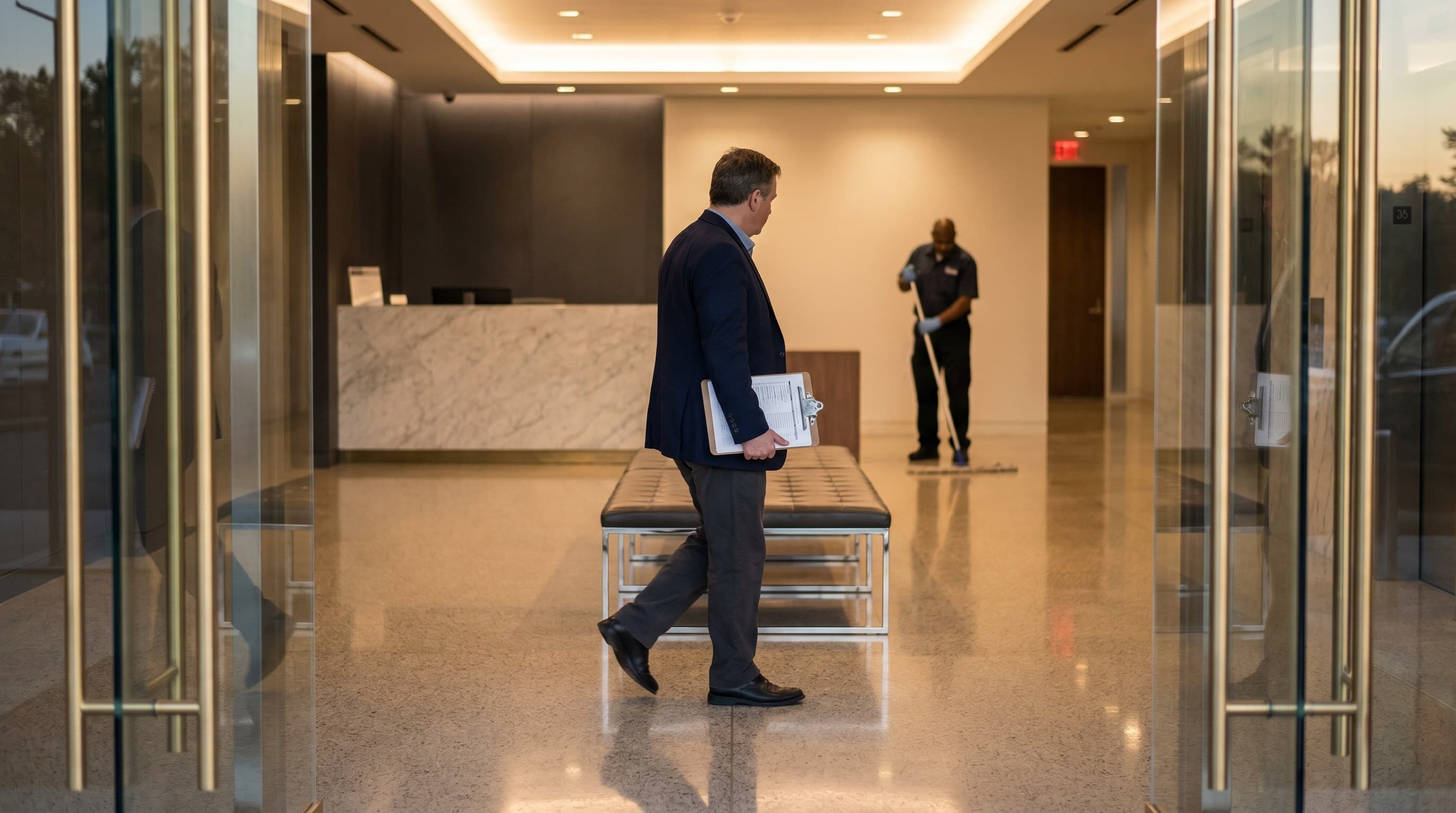
The audit breaks into five parts, in this order: scope versus reality, surface condition walk, paper trail check, staffing and SLA, then cost per square foot benchmark. Each part takes about 10 minutes on a typical 30,000 to 60,000 square foot building. Total time is under an hour with a clipboard, the original contract, and any photo audits or service tickets from the past 90 days.
Part 1: Scope Versus Reality
Pull the original cleaning scope of work out of the contract. Walk the building with it. Mark every line item against what is actually happening:
- Daily tasks. Trash, restrooms, vacuuming common areas, spot-cleaning glass. Are they happening every day they should? The receptionist usually knows.
- Weekly tasks. Full vacuuming under desks, dusting blinds and baseboards, restroom partition wipedown, mop refresh. These slip first.
- Monthly tasks. High dusting, vent grilles, light fixture cleaning, polishing, kitchenette deep clean. These slip almost universally if no one is checking.
- Quarterly tasks. Carpet extraction, floor recoat or strip, exterior window cleaning, HVAC vent dusting. These get billed but skipped on cheap contracts.
- Annual tasks. Floor strip and wax, deep carpet extraction, upholstery cleaning, ceiling tile replacement. These get pushed to year two and quietly disappear.
The slip pattern is predictable. Daily holds. Weekly slips by month 3. Monthly slips by month 5. Quarterly is the line where most non-audited contracts start losing real money for the building owner. If you can find three quarterly tasks that have not been done since January, you have already paid for the audit.
Part 2: Surface Condition Walk
The scope sheet says what should be happening. The surfaces say what actually happened. Walk the building and look at the things that show wear or buildup over weeks, not days:
- Baseboards. A clean building has clean baseboards in the corners. A drifted building has scuff lines and dust ridges where the mop never reached.
- Restroom partitions. Under the toilet paper holder. The back of the partition next to the wall. The floor seam at the partition base. These are the tells.
- HVAC vent grilles. A two-month buildup of dust on the supply diffusers in your conference room means dusting frequency is not happening.
- Door frames and door tops. Run a finger across the top of an interior door. If the finger comes back gray, the monthly schedule is not running.
- Floor edges and elevator tracks. Daily mopping and vacuuming hit the middle of every floor. The edges and tracks show whether anyone is actually following the wall.
- Glass at fingerprint height. Lobby glass below 5 feet should be clean. Above 5 feet shows whether the porter is rushing.
- Kitchen and break room. Inside the microwave. Under the coffee maker. Behind the refrigerator. The vendor's contract probably says these are weekly. The reality is usually monthly at best.
Photograph the problem spots. Photo audits are how contracts get renegotiated.
Part 3: Paper Trail Check
Pull the past 90 days of:
- Service tickets or check-in logs. Most professional janitorial services log entry and exit times. Compare logged time on site against the contracted hours. A four-hour nightly clean that is actually a 2.5-hour visit four nights a week is a contract breach worth thousands of dollars annually.
- Issue reports. Every complaint that came in from tenants or staff. Track how long resolution took and whether the same issue is recurring. Recurring complaints in the same zone usually mean the vendor's route is wrong, not that the cleaner is bad.
- Supply restocking logs. Paper goods, soap, liners. Are restocks happening on schedule or are tenants calling because the dispensers are empty?
- Photo audits if the vendor uses them. Some vendors send photo proof of completed work. We do this for our medical and class-A office accounts. If your vendor offers them and you have not been looking at them, look at them this week.
The paper trail tells the story the walk-around cannot. The vendor who is on site 25% less time than billed is the vendor who is going to lose the next renewal.
Part 4: Staffing and SLA
Ask the vendor in writing: who is on your account this week? Names, hours, roles. Compare to the staffing plan in the original contract.
The pattern we see in audits of competitor accounts:
- The lead supervisor named in the proposal has rotated off. The replacement is junior or part-time.
- Original four-person crew is now a three-person crew. Same scope, less staffing. Drift starts here.
- Backup coverage for sick calls has disappeared. The cleaner who calls out on Tuesday means Tuesday's restroom round just got skipped. No make-up day is scheduled.
- The day porter named in the contract is a different person every week. No continuity, no learning curve, every shift starts at zero.
Hold the vendor to the staffing they sold. If the team has changed, the contract should have been renegotiated. If it was not, you have bargaining power. A rotating crew is also the first of the seven signs your cleaning company is failing you, so if the faces keep changing week to week, treat it as an early warning and not a scheduling quirk. For the staffing questions that belong in the walkthrough before you ever get here, see will it be the same crew in your building every week. We covered the staffing question more deeply in our in-house versus outsourced cleaning comparison, which is worth a re-read at audit time.
Part 5: Cost Per Square Foot Benchmark
The simple math. Divide the annual contract dollar figure by the square footage cleaned. Compare against the NJ commercial cleaning market for your building type:
- Standard Class A office, 5-day service: $1.80 to $2.80 per square foot per year in the Monmouth and Ocean County market.
- Medical and dental offices, 5-day service with biohazard: $3.00 to $4.50 per square foot per year.
- Retail spaces, 6 or 7-day service: $1.50 to $2.50 per square foot per year.
- Industrial and warehouse, 5-day service with restrooms and breakroom: $0.70 to $1.40 per square foot per year.
- Day porter coverage (additional, 4 to 8 hours daily): $25,000 to $55,000 per year.
If you are paying $4.20 per square foot on a standard Class A office, the contract is overpriced. If you are paying $0.90, the contract is underpriced and the corner-cutting you found in Part 2 is why. The honest range is the range. Outside it, in either direction, you have a problem. We walked through the full pricing math in our NJ commercial cleaning cost guide if you want the longer breakdown.
What to Do With the Audit Findings
Three outcomes are possible after a real audit.
Outcome 1: vendor passes. Surfaces are clean, paper trail matches the contract, staffing is the same crew that started in January, cost per square foot is in range. Renew the contract on existing terms when it comes up. Tell the vendor what you audited and that you appreciate the consistency. Vendors that pass an unannounced audit deserve to know.
Outcome 2: vendor is drifting but recoverable. A few quarterly tasks missed, some surface buildup, paper trail mostly aligned. This is the classic one-year slide, and why a commercial cleaning company gets worse after a year explains the crew-rotation cause and how to head it off. Send the vendor a written summary of the gaps with a cure window, usually 10 to 30 days depending on what your contract actually specifies. Photo audits attached. Tell them the contract is up for review and the gaps need closing before renewal conversation. A vendor that fixes everything inside the window is usually a long-term keeper. If your current contract does not spell out a cure period at all, that is worth fixing at renewal; we broke down what belongs in a cleaning contract beyond the price line, cure period included.
Outcome 3: vendor is in breach. Significant scope items not happening, hours billed not on site, supply restocking unreliable, staffing changed without notice. Put the breach in writing, cite the contract clauses, and start interviewing replacements. Most NJ commercial cleaning contracts include a 30 or 60-day termination clause for cause. Use it. The cost of waiting out a bad contract until December renewal is higher than the cost of switching vendors mid-year. We covered the vendor selection criteria in detail in our how to choose a commercial cleaning company guide.
How C&S Handles Audits on Our Own Accounts
Every account we run gets a quarterly internal audit using this same five-part frame. We photograph the spots that fail. We email the building contact a one-page summary of what passed, what slipped, and what we are correcting. Then we correct it before the next inspection.
The reason is simple: the buildings that hold us accountable get a better service for the same money. The buildings that do not audit drift the same way every other vendor's accounts drift. We would rather have audited clients than unaudited ones, even when the audit catches us short on something. If you want the between-audit version of this, the proof you should be able to pull on any single night, we laid out how to verify office cleaning was actually done, service record, photos, and inspection score included.
Updated September 2026.
If you manage a commercial building in Monmouth or Ocean County and you have not audited your current vendor in the past six months, run this checklist in the next two weeks. If you want a second set of eyes on the building before you renew, that is what we do. Schedule a walkthrough and we will walk the building with you, scope sheet in hand, no pressure on switching vendors.
Need a Professional Opinion?
Get a complimentary onsite assessment of your commercial space in New Jersey.
Request Consultation