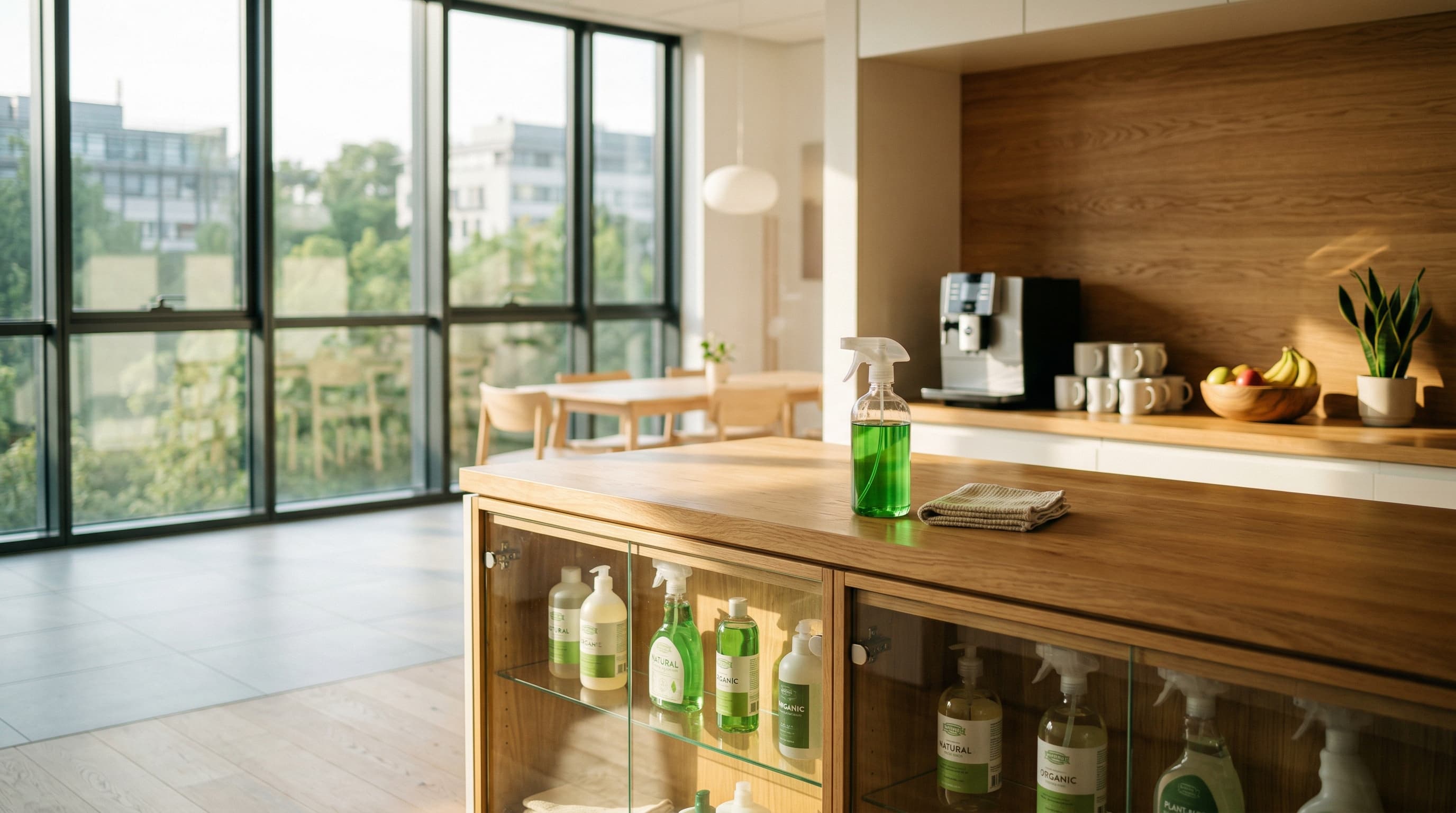
Green Commercial Cleaning: What NJ Businesses Need to Know
Eco-friendly cleaning products are taking over commercial facilities in New Jersey. Here's what actually works, what's marketing hype, and how to make the switch without sacrificing results.
The cleaning crew just left. The floors are spotless, the bathrooms are gleaming, and the break room smells like... a chemical plant. Your employees are opening windows. Someone in accounting is complaining about headaches again. And you're starting to wonder if there's a way to get a clean building without the chemical assault.
There is. But the green cleaning market is a minefield of overblown claims, misleading labels, and products that cost twice as much while cleaning half as well. Here's what New Jersey facility managers actually need to know before making the switch.
What Is Green Commercial Cleaning, Exactly?
Green commercial cleaning means using products, equipment, and methods that reduce environmental impact and health risks without compromising cleaning effectiveness. Swapping one spray bottle for another is the smallest part of it. Done properly, it's a system-wide approach that covers chemical selection, dilution ratios, equipment efficiency, waste reduction, and indoor air quality management.
The key distinction: genuinely green cleaning products are certified by third-party organizations like Green Seal (GS-37 for industrial cleaners) or EPA's Safer Choice program. If a product just says "natural" or "eco-friendly" on the label without certification, that's marketing, not verification.
Are Green Cleaning Products Actually Effective?
Yes, but not all of them. The green cleaning products available in 2026 are dramatically more effective than what existed even five years ago. Enzyme-based cleaners, hydrogen peroxide formulations, and plant-derived surfactants now match or exceed the performance of traditional chemicals for most commercial applications.
Here's where they excel and where they struggle:
| Application | Green Product Performance | Notes | |---|---|---| | General surface cleaning | Excellent | Plant-based surfactants handle daily grime effectively | | Floor stripping & waxing | Good | Hydrogen peroxide strippers work well, may need longer dwell time | | Restroom disinfection | Very good | EPA-registered hydrogen peroxide disinfectants meet healthcare standards | | Carpet cleaning | Excellent | Enzyme-based cleaners often outperform traditional extractors on organic stains | | Grease removal (kitchens) | Moderate | Heavy industrial grease may still require targeted solvents | | Post-construction cleanup | Limited | Adhesive removal and concrete residue still need specialized products |
For most NJ offices, retail spaces, and medical facilities, green products handle 90%+ of daily cleaning tasks without compromise. The remaining edge cases (heavy industrial degreasing, construction residue, specific hospital-grade disinfection protocols) may still require conventional products used strategically.
How Much More Does Green Cleaning Cost?
This is where most facility managers we talk to get surprised (in a good way). The cost difference is smaller than you'd expect, and in some cases green cleaning actually reduces total spend.
Product cost: Green-certified concentrates run 10-20% more per gallon than conventional equivalents. But modern dilution systems mean you're using less product per application, which narrows or eliminates the gap.
Equipment: HEPA-filtered vacuums, microfiber systems, and metered dispensing equipment represent an upfront investment ($2,000-$5,000 for a typical 10,000 sq ft facility) that pays back within 12-18 months through reduced product waste and longer surface life.
Hidden savings: Where green cleaning actually wins on cost:
- Reduced absenteeism: fewer VOCs means fewer headache complaints and sick days. A Carnegie Mellon study found improved indoor air quality can reduce short-term sick leave by 35%.
- Surface longevity: gentler chemicals extend the life of carpets, hard floors, and fixtures
- Regulatory compliance: NJ's Indoor Environmental Quality standards (N.J.A.C. 12:100-13) are getting stricter. Getting ahead of requirements now avoids costly retrofitting later.
- Liability reduction: fewer chemical exposure complaints means lower insurance risk
For a typical 5,000-10,000 sq ft New Jersey office, expect total cleaning costs to increase 5-10% during the transition period, then level out or decrease within six months.
What Certifications Should You Look For?
Not all "green" labels mean the same thing. Here are the certifications that actually matter for commercial cleaning in New Jersey:
- Green Seal (GS-37, GS-40, GS-41): the gold standard for institutional cleaners. Tests for both environmental impact AND cleaning performance.
- EPA Safer Choice: verified by the EPA to contain safer chemical ingredients. Required for many government and education contracts in NJ.
- UL ECOLOGO: tests for reduced environmental impact across the product lifecycle, from manufacturing through disposal.
- ISSA CIMS-GB (Green Building): certifies the cleaning organization itself, not just the products. Verifies the entire operation follows green protocols.
What to ignore: "Biodegradable" (everything is, eventually), "Natural" (arsenic is natural), "Chemical-free" (water is a chemical). If there's no third-party certification logo, the claim is unverified.
How Do You Transition Without Disrupting Operations?
The biggest mistake we see NJ businesses make with green cleaning is trying to switch everything overnight. A phased approach prevents disruptions and lets you measure results:
- Audit your current chemical inventory: list every product your cleaning crew uses, the application, and the monthly volume. This becomes your baseline.
- Prioritize high-exposure areas first: break rooms, restrooms, and common areas where employees have the most chemical contact. Switch these to green products in month one.
- Train your crew on dilution ratios: green concentrates often have different dilution requirements than conventional products. Over-diluting is the #1 reason facility managers think green products "don't work."
- Phase in remaining areas over 60-90 days: offices, corridors, and specialty areas transition next. Keep conventional products available for edge cases.
- Measure and adjust: track complaints, product usage, and cleaning quality scores for 90 days. Adjust product selection and application methods based on actual results.
A professional daily and weekly cleaning service that already uses green protocols eliminates the transition entirely: you inherit their certified products, trained staff, and proven processes from day one.
Does Green Cleaning Meet NJ Health Code Requirements?
Yes, with the right product selection. New Jersey's health codes for commercial facilities require specific disinfection standards, particularly in:
- Food service: NJ Food Code (N.J.A.C. 8:24) requires EPA-registered sanitizers. Multiple green-certified options now meet these standards, including hydrogen peroxide and citric acid-based sanitizers.
- Healthcare: medical facilities must use products on the EPA's List N (for pathogen-specific claims). Several Green Seal-certified disinfectants appear on this list.
- Childcare and education: NJ requires specific cleaning and sanitization protocols for licensed facilities. Green products meeting EPA Safer Choice DfE standards are accepted.
The key is selecting products that carry BOTH the green certification AND the required EPA registration numbers for your facility type. A cleaning company experienced in NJ regulatory requirements will already have this dialed in.
What Should You Ask Your Cleaning Company?
If you're evaluating cleaning companies on their green credentials, these five questions separate the genuinely green from the greenwashed:
- "Can you show me the Safety Data Sheets and certifications for every product you'll use in my facility?" If they can't produce these on request, walk away.
- "What's your dilution control system?" Proper green cleaning requires metered dispensing, not eyeballing from a bottle.
- "How do you handle applications where green products fall short?" The honest answer is "we use targeted conventional products for specific situations." Anyone claiming 100% green for every application is overpromising.
- "What training does your staff receive on green cleaning methods?" Product selection is only half the equation. Application technique matters.
- "Do you hold any organizational green certifications (CIMS-GB, ISSA)?" This verifies the company's commitment goes beyond buying different bottles.
Green Works When the Crew Knows the Chemistry
Green commercial cleaning in 2026 is a competitive advantage, and the trade-off people worry about has mostly disappeared. The products work, the costs are manageable, and the benefits to employee health and regulatory compliance are real. The catch is that you need a cleaning partner who actually understands the science, not one who just slaps "eco-friendly" on their truck.
If your current cleaning crew can't answer those five questions above, it might be time for that free walkthrough. We'll audit your space, identify which green products match your facility type, and build a cleaning plan that keeps your building spotless without the chemical hangover.
Call C&S at (908) 894-3871 or request your free assessment. We'll show you what green cleaning actually looks like when it's done right.
Need a Professional Opinion?
Get a complimentary onsite assessment of your commercial space in New Jersey.
Request Consultation