How to Verify Office Cleaning Was Done in NJ Buildings
A $650 cleaning charge went viral because nobody could prove the work happened. Here is how to verify office cleaning was done, and what proof to demand.
How to verify office cleaning was done comes down to three documents you should be able to pull on demand: a dated service record for every visit, before-and-after photos of the work, and an inspection score signed by someone who did not do the cleaning. In August 2026 a facility manager posted a $650 cleaning charge to r/PropertyManagement and pulled 192 comments in a day. Almost nobody argued the price. The top reply, at 72 upvotes, told the manager to ask for an itemized receipt with before-and-after pictures, and it flat out doubted the vendor could produce one. Two more replies, at 63 and 30 upvotes, said the same thing in different words. Nobody in that thread was fighting the money. They were fighting the lack of proof.
Updated September 2026.
C&S Commercial Cleaning has cleaned buildings across New Jersey since 2014, and that thread describes a problem we take over constantly. A building pays every month, and nobody can say for certain what happened after the lights went out. So here is how the work should be documented, from the vendor who already does it and has nothing to lose by telling you.
An Invoice Line Is a Request To Be Trusted
One line on an invoice that reads "monthly cleaning, $650" is not a bill. It is a request to be trusted, and trust is the thing a good vendor should be making unnecessary. A real itemized cleaning invoice ties the dollar figure to dated visits, a task list for each visit, and the square footage cleaned. You should be able to look at it and see the nights we were in your building and what got done on each one.
Watch for scope migrating. Work that used to be included quietly becomes a separate charge, and the total creeps. When we take over an account, the first thing we ask for is the last three invoices from the old vendor. Half the time the line items got vaguer every quarter. That is not a billing quirk. That is a company that stopped wanting you to look closely.
What a Nightly Service Record Should Contain
A nightly service record is the smallest honest unit of proof, and most vendors skip it because it holds them accountable. At minimum it carries the date, the crew on site, the time in and the time out, and the tasks completed against the written scope. A four-hour nightly clean that is really a 90-minute visit shows up here first, and nowhere else.
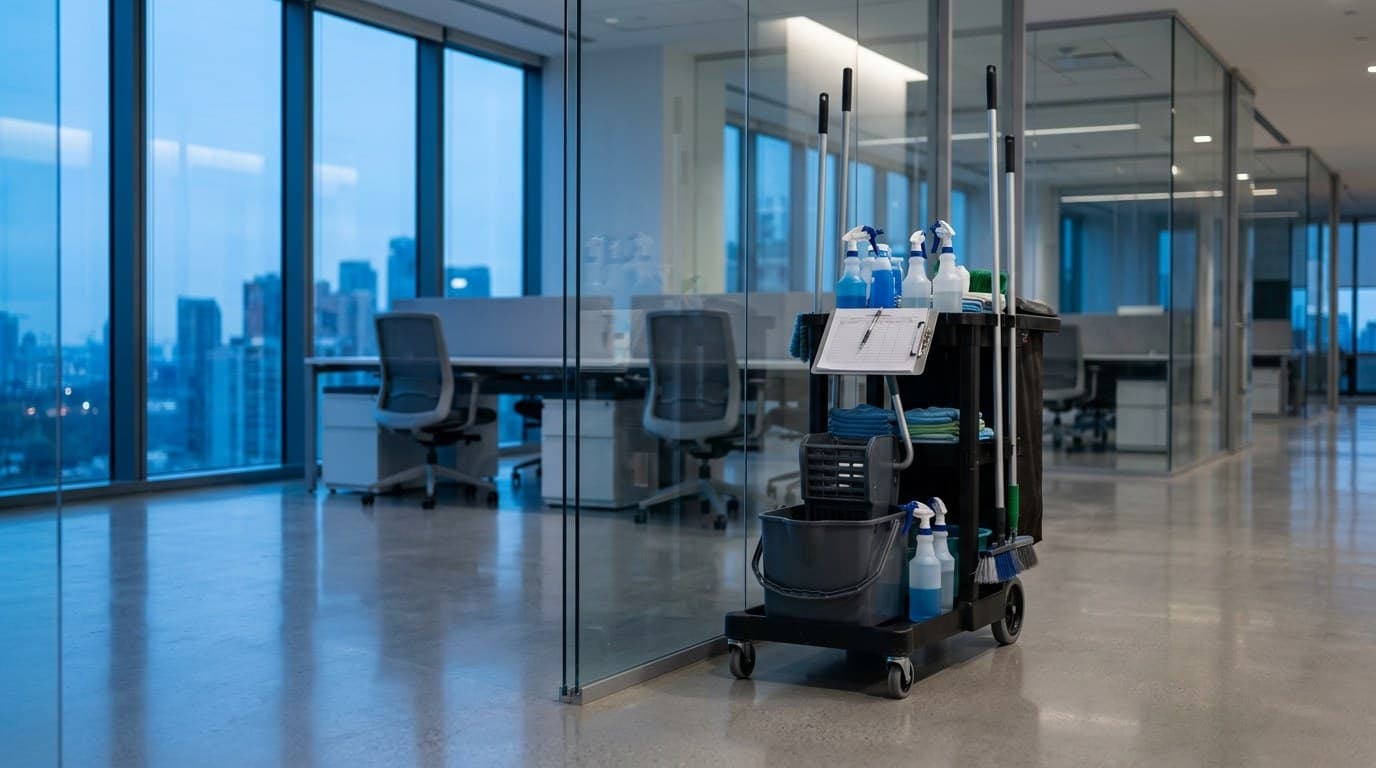
Our crews leave a dated checklist on the same clipboard by your supply closet, marked visit by visit, so the record lives in your building and not on our server where you cannot see it. That one detail changes the relationship. When the log is in the room, a skipped restroom round is obvious by Tuesday. When it lives only with the vendor, you find out in month ten, on a walk-through, angry. A cleaning quality control checklist is worth nothing if the only person who ever reads it is the person filling it in.
Photos, Timestamps, and What They Cost a Vendor To Produce
The Reddit thread landed on before-and-after photos for a reason. A photo with a timestamp is the hardest proof to fake and the cheapest to demand. It also costs a vendor something real, which is exactly why the honest ones offer it and the coasting ones resist.
Here is the cost. Photos take crew minutes, they create a record that can be held against you, and they remove every excuse. A company backfilling your building with a rotating part-time crew cannot produce consistent photo proof, because the people change every week and nobody owns the standard. We photograph the spots that fail most often on our medical and Class A office accounts, and we attach them to the same-night summary. If a vendor tells you photo logging is not possible, what they mean is it is not possible for the way they staff your building.
Who Inspects the Work, How Often, and Who Sees the Score
An inspection run by the person who did the cleaning is not an inspection. It is a signature. Janitorial SLA scoring only means something when a supervisor who was not on the mop walks the building against the scope, marks each task pass or slip, and sends the result to you, not to a folder you never open. Who signs it matters more than the number on it.
The cadence should be written down. On a new account we inspect every visit for the first few weeks, then hold at monthly once the standard proves out. And the building contact gets the score. That is the part almost every competitor drops, because a score you never see cannot embarrass anyone. The mid-year janitorial vendor review lays out the full five-part frame we run on our own accounts, including the ones we would rather not fail.
When a Task Gets Missed, Who Is Supposed To Catch It First
One missed night is human. The question that separates a partner from a liability is who finds the miss first. It should be the vendor, in writing, before you do. When our crew catches a slip on inspection, the building contact gets a one-page note the same night saying what slipped and what we corrected. You should not be our quality control department.
A rotating crew is the tell that this will never happen, and it is the first of the signs an office cleaning company is failing you. New faces every week means no one owns your floor plan, so no one notices the thing that got skipped. Proof of service janitorial work only holds when the same people come back and answer for the last visit. Continuity is not a nicety. It is the mechanism that makes accountability possible at all.
Spot Checks You Can Run in Ten Minutes Tonight
You do not need to wait for a report. After the crew has been through, give yourself 10 minutes and run these. Drag a finger across the top of an interior door frame. Gray means the monthly high-dusting is not running. Open two restroom dispensers. Empty on a Thursday means nobody is restocking on a schedule. Wipe one shared door handle with a white paper towel. Residue means it got wiped for looks, not sanitized. Look at the baseboards in one corner for the dust ridge the mop never reached.
Then do the paper version. Ask the vendor, in writing, for last night's service record and the most recent inspection report. Time how long it takes them to send both. A company that documents the work answers in an afternoon. If you are lining up a new vendor, our recurring daily, weekly, and monthly janitorial service is built on fixed crews, per-visit checklists, and scheduled inspections, and we will show you the paperwork before you sign, not after.
When the records show something was skipped, the next step is reporting it properly, which we cover in what should happen after a cleaning task gets missed.
Frequently asked questions
How do I verify my office cleaning was actually done?
Ask for three things you can pull on demand: a dated service record for every visit with entry and exit times, before-and-after photos of the work, and an inspection score signed by someone who did not do the cleaning. If a vendor can produce all three within a day, the work is real and you can stop guessing. If they stall on any of the three, you already have your answer. We build all three into every C&S account because the buildings that ask for proof are the ones that get better service.
The vendor sent a $650 invoice with one line. Is that normal?
A single line is a request to be trusted, not a bill you can check. A real invoice ties the dollar figure to dated visits, a task list per visit, and the square footage cleaned, so you can see what you paid for. When work that used to be included shows up as a surprise charge, that is scope quietly walking out the door. Ask the vendor to itemize the $650 against actual service dates. If they cannot, the number is a guess wearing a total.
What should a janitorial inspection report contain?
Date and time of the inspection, who ran it, the tasks checked against the written scope, a pass or slip mark on each, photos of anything that failed, and what got corrected before the next visit. A score matters less than who signs it. An inspection run by the same person who cleaned the building is not an inspection, it is a signature. We run ours on a set schedule and email the building contact a one-page summary the same night, so a dip gets caught by us before you ever notice it.
How often should someone inspect the cleaning, and who should do it?
On a recurring contract, a scheduled inspection every visit for the first few weeks, then no less than monthly once the standard holds, run by a supervisor who is not the cleaner. The point of a set schedule is that it does not depend on you complaining. Most drift starts because nobody was checking, and the vendor knew it. If your current company has never inspected your building in writing, that gap is the reason quality slid.
What proof should I ask for before I sign a cleaning contract?
Ask to see a sample service record, a sample inspection report, and the cure window in writing, usually 10 days. Ask who supervises your building and how often. A company that already documents its work will hand these over in an afternoon. A company that has to invent them is telling you what year two looks like. We would rather show a prospect our paperwork than talk about it.
Need a Professional Opinion?
Get a complimentary onsite assessment of your commercial space in New Jersey.
Request Consultation