Commercial Break Room and Office Kitchen Cleaning in NJ: Why the Smell Always Starts Here and How to Fix It for Good
Almost every odor complaint in a New Jersey office building traces back to the same room: the break room. Here is what an actual break room cleaning protocol looks like for offices, medical suites, and warehouses across Monmouth and Ocean County, and why the standard nightly wipe-down is not it.
When a facility manager calls us about a smell complaint in their building, the answer is almost never what they think it is. It is rarely the carpets. It is rarely the HVAC. It is rarely the bathrooms, although those get blamed first. The smell is almost always coming from one room, and that room is the break room.
Office kitchens and break rooms are the most-used and most under-cleaned spaces in a commercial building. They get wiped down by the night crew, the trash gets pulled, and on paper they are "done." But the smells that show up by Wednesday afternoon, the sticky cabinet handles, the funky microwave odor, the brown ring inside the refrigerator drawer — those come from work the standard nightly checklist does not cover. And in a New Jersey summer, with humidity over 70% most of the season, every one of those small misses turns into a real complaint by Thursday.
Here is how an actual break room cleaning protocol should run in an office, medical suite, or warehouse across Monmouth and Ocean County, what gets missed in a standard janitorial scope, and how to write the scope so the room you spend money cleaning every night actually stays clean.
Why the Break Room Is Always the Source
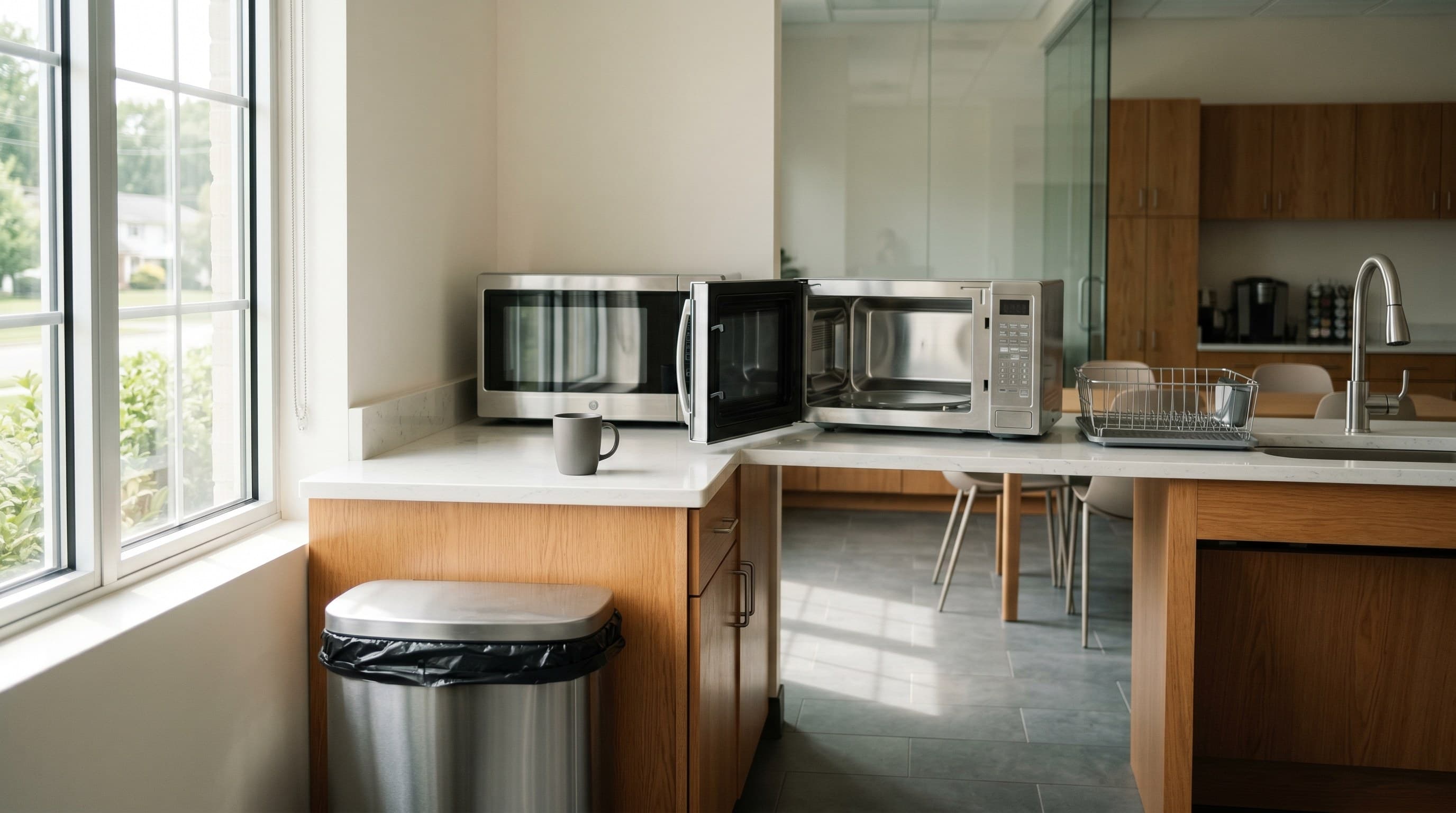
A break room concentrates more odor sources into less square footage than any other room in the building. Walk into one and add up what is in there: a refrigerator full of opened food, a microwave that splatters daily, a sink with a disposal or a drain that traps food particles, a trash can that fills with banana peels and yogurt cups, a coffee maker that grows mold in the reservoir, sometimes a dishwasher, and a set of cabinets that get touched by every hand in the office before lunch. That is more bacterial and organic-matter activity in one room than the entire rest of the floor combined.
Then add a Jersey summer. Humidity above 70% slows everything from drying out. Trash that would have been dry by morning in February is still damp. Crumbs trapped in the toaster oven crisp into a burnt sugar smell. The disposal trap, the dishwasher drain line, and the bottom of the trash can all hold moisture that bacteria feed on. By Wednesday the room has its own atmosphere, and it spreads, because the break room rarely has its own exhaust. The smell rides the return air and shows up at the front desk.
This is not a cleaning crew problem. It is a scope problem. Almost every commercial cleaning contract specifies "wipe surfaces, empty trash, mop floor" for the break room and stops there. The work that actually controls the smell is not on the list.
What a Standard Nightly Checklist Misses
Here is what a typical commercial cleaning scope covers in a break room, and what it leaves on the table.
The standard scope: wipe down the counters, the table surfaces, and the front of the appliances. Pull the trash and reline. Sweep and mop the floor. Spot-clean the sink. Restock paper towels.
What it misses, every single night:
- The inside of the microwave, where food splatters cook onto the walls and ceiling and become the source of half the "burnt smell" complaints by midweek.
- The refrigerator interior, where spills sit in the drawers and on the door shelves until someone organizes a quarterly clean-out that never actually happens.
- The garbage disposal, sink drain, and the trap underneath, where food particles accumulate and the bacterial film grows in the dark.
- The coffee maker reservoir and the inside of the kettle, where mold and biofilm grow in standing water if they are not descaled and dried.
- The bottom of the trash can underneath the liner, where any small leak from a previous bag has been collecting for weeks.
- The toe-kick under the cabinets and the gap between the refrigerator and the wall, where crumbs and spills end up and never get vacuumed out.
- The cabinet pulls, the handle on the refrigerator, the microwave touchpad, and the coffee maker buttons, which are touched by every employee and almost never disinfected.
- The dishwasher gasket and drain filter, which collect food residue and develop their own smell.
Every single one of those is a known and recurring odor source. None of them get touched on the standard nightly. That is why the break room smells.
The Protocol That Actually Works
A break room that stays clean through a New Jersey summer needs three different layers of cleaning, run on three different cadences. Skip any one and the smell comes back.
Layer one: nightly
Every night the room gets the basics, done correctly. Counters, table tops, sink, faucet, and the front of every appliance wiped down with a disinfectant cleaner with a real dwell time, not a quick spray-and-wipe that the chemistry never has time to work on. Trash pulled, can wiped inside and out, fresh liner. Floor swept and mopped, including the toe-kick under the cabinets. High-touch points — refrigerator handle, microwave touchpad, coffee maker buttons, sink faucet, cabinet pulls, light switches — sanitized with a disinfectant wipe. Disposal flushed with hot water and a fresh enzyme treatment.
That is the floor. It is what every contract should already include, and most do not.
Layer two: weekly
Once a week, on a set night, the cleaning crew does the work the nightly does not have time for. Microwave interior pulled apart, plate removed, walls and ceiling scrubbed with a degreaser, plate run through the dishwasher or hand-washed. Refrigerator interior wiped on every shelf and drawer (this requires a written, posted policy that anything unlabeled or expired gets tossed, otherwise the crew cannot touch employees' food). Coffee maker and kettle descaled and the reservoir washed and dried. Sink drain treated with an enzyme cleaner. Dishwasher filter pulled and rinsed, gasket wiped. Toaster and toaster oven crumb tray emptied and washed. Trash can pulled out, sprayed inside, scrubbed, and dried before a new liner goes in.
Weekly is the layer most janitorial contracts skip entirely or do "as time permits," which means never.
Layer three: monthly deep
Once a month the room gets pulled apart. Refrigerator pulled away from the wall, behind and underneath vacuumed. Coils on the back of the fridge brushed (a clogged coil makes the fridge work harder and warmer, which makes food spoil faster, which makes the smell worse). Cabinets emptied if possible and the shelves wiped. Gap between the wall and the appliances cleaned. Light fixtures and air vents above the room wiped (those collect grease aerosol from the cooking surfaces). Floors machine-scrubbed instead of mopped, because mop water on a vinyl or VCT floor over time builds a sticky film that holds soil.
The monthly is what keeps the room from getting visibly grimy after the third or fourth month, and what every break room should have on the calendar.
The Trash Setup That Stops the Smell at the Source
The single highest-leverage change a facility manager can make to break room smell is fixing the trash setup, and almost no building does this correctly.
The right setup: a sturdy commercial trash can with a tight-fitting lid (a step-can or a swing-top is fine, an open-top is not), lined with a properly sized heavy-duty liner that is changed nightly and not when "it looks full." A bag rated for the volume of the can, not the cheap 13-gallon liner that splits under a yogurt cup. The can interior gets wiped down inside-and-out at least weekly with a disinfectant. Food waste, when possible, goes in a separate, smaller, lidded can with a more aggressive change schedule (every shift or every day for a busy office).
In an office where lunch is heavy on takeout and food waste runs high — especially common in medical suites and any building with no on-site cafeteria — the standard 23-gallon office trash can is the wrong tool. It holds smell. A purpose-built food-waste setup pays for itself in eliminated complaints within a month.
A Word on Disposals and Drains
Drains are the second most-common smell source after trash. A sink drain in a commercial break room is a wet, dark, food-particle environment. Pouring bleach down it will kill the smell for a day and not fix the cause. The fix is an enzyme drain treatment poured weekly, which actually digests the biofilm growing on the inside of the pipe walls. The same goes for any floor drain in the room. We carry an enzyme product on every account and treat the drains on a weekly rotation, and it is one of the cheapest interventions with the highest impact on smell complaints.
How to Write a Cleaning Scope That Actually Covers the Break Room
If you are a facility manager hiring or reviewing a commercial cleaning contract in Monmouth or Ocean County, here is what the break room scope should specifically include. Most contracts have one line for the break room. It should have eight.
- Nightly: counters, tables, appliance exteriors, sink, floor, trash with full liner change, high-touch points sanitized, disposal flushed with enzyme treatment.
- Weekly: microwave interior, refrigerator interior, coffee maker descaled, dishwasher filter cleaned, trash can interior scrubbed, sink drain enzyme-treated, toaster crumb tray cleaned.
- Monthly: refrigerator pulled and behind cleaned, coils brushed, cabinet exteriors and shelves wiped, vents above wiped, floor machine-scrubbed.
Put it in writing in the contract. A scope that lists what gets done at what cadence is one a vendor cannot quietly drop, and is one you can hold them to when the smell shows up anyway.
What We Do for NJ Buildings
Every commercial account we run across Monmouth and Ocean County has the break room broken out as its own three-layer scope, not buried inside the general office cleaning line. The nightly is run on every visit. The weekly happens on a set day every week. The monthly is on the calendar and tracked. The trash setup is right-sized for the building's actual food-waste volume, and drains get treated on a rotation so they never become the source of a complaint instead of the symptom.
We covered the broader summer cleaning load that stacks on top of all of this in our summer commercial cleaning checklist for NJ offices, the restroom side of the smell problem in our commercial restroom cleaning standards guide, and the HVAC piece, which can amplify a break room smell across the whole floor, in our office HVAC and air quality guide. The break room is the source most often, and it is the one most often outside the scope of the contract that should be covering it.
If your building is fielding "what is that smell?" complaints in the afternoon and the cleaning crew keeps insisting the room looks clean, the room probably does look clean and the smell is still coming from in there. Send us a note describing the building and the current scope and we will tell you what is most likely off and what the right three-layer protocol would look like for your space.
Need a Professional Opinion?
Get a complimentary onsite assessment of your commercial space in New Jersey.
Request Consultation