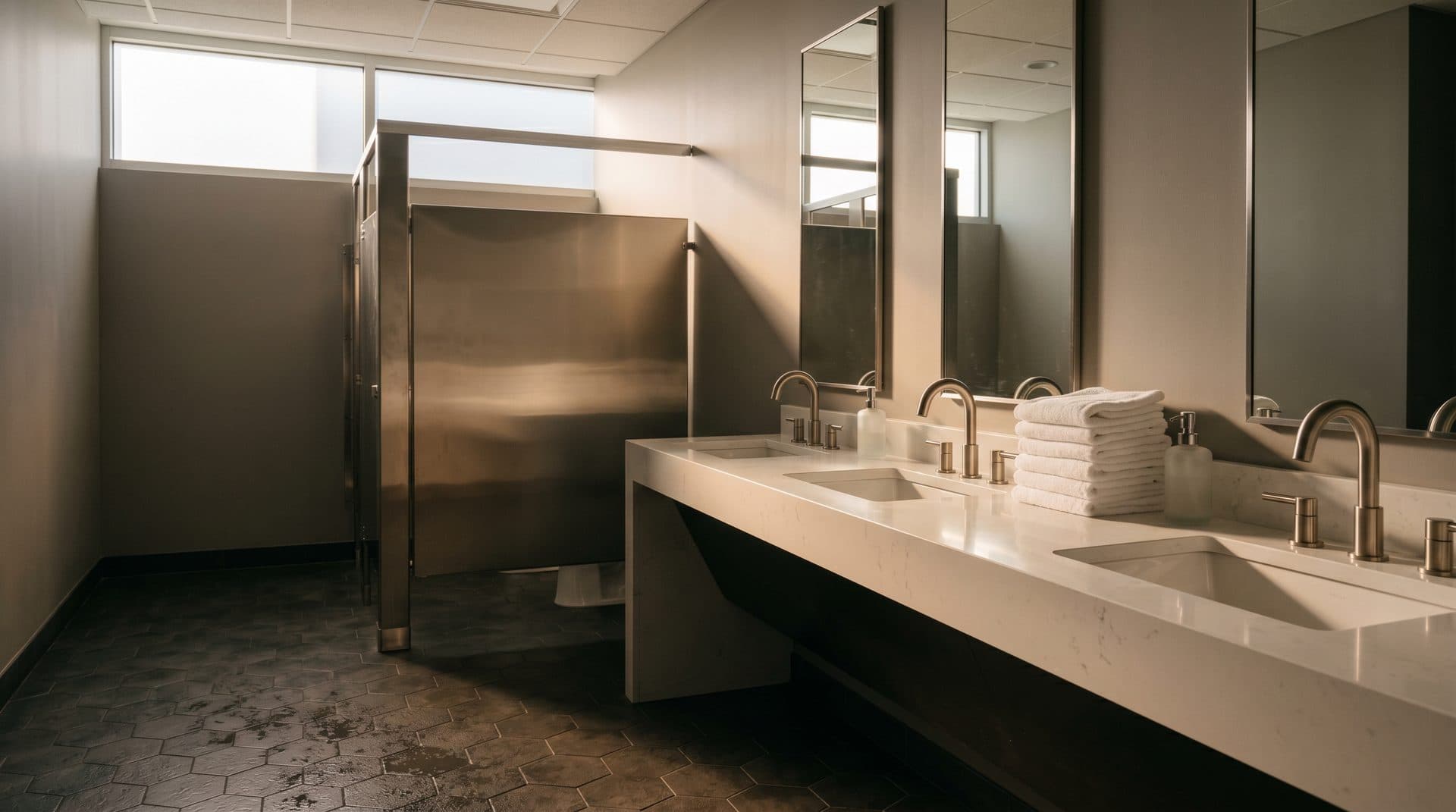
Commercial Restroom Cleaning Standards: What NJ Facility Managers Should Be Demanding
The restroom is the single biggest tenant complaint generator in any NJ office or retail building. Here is what a real commercial restroom cleaning program looks like, what should be on the daily and weekly checklist, and the questions facility managers should be asking their vendor.
Pull the tenant complaint log for any office building in Monmouth or Ocean County and the same word shows up in roughly half the entries. Restroom. Toilets not flushed. Soap dispenser empty. Floor wet. Trash overflowing. A smell that should not be there. We have been cleaning commercial buildings across NJ for years and the pattern is consistent. The restroom is the single highest-impact room in the entire facility, because it is the one a tenant uses six times a day and forms an opinion about every single time.
A clean restroom is invisible. A dirty restroom is the only thing a tenant remembers about the building. That asymmetry is why facility managers should be holding the janitorial vendor to a real, written restroom standard, not a vibe.
This post lays out what a serious commercial restroom cleaning program actually looks like, what should be on the daily and weekly checklist, and the questions to put to the vendor on the next walkthrough. If you are not already running a vendor audit, our mid-year janitorial vendor review guide is the broader framework. This is the restroom-specific drill-down.
Why Restrooms Are the Highest-Stakes Room in the Building
Three things stack up at once in a commercial restroom and nothing else in the facility hits all three.
First, it is the highest-touch room in the building. Every tenant touches the door handle, the stall latch, the flush valve, the faucet, the soap dispenser, the paper towel lever, and the exit handle in under two minutes. Every one of those surfaces is shared by hundreds of people a day.
Second, it is the highest-moisture room in the building. Water hits the floor, the partitions, the walls, and the counters constantly. Wherever moisture sits, biology grows. The smell that defines a "bad" restroom is almost always biofilm in a urinal trap, on a floor grout line, or under a toilet flange.
Third, it is the most-judged room in the building. A tenant who walks into a stained, smelly, or out-of-supplies restroom does not call it a cleaning failure. They call it a building failure. The owner gets the complaint, not the vendor.
If your janitorial contract treats the restroom as one line item among many, you are mis-pricing the most important room you have.
The Daily Restroom Checklist Your Vendor Should Be Running
This is the minimum daily list that gets done on every Class A and Class B commercial building we clean in Monmouth and Ocean County. It is not aspirational. It is the floor.
- Restock all dispensers. Toilet paper, seat covers, hand towels or hand-dryer functioning, hand soap, sanitizer. If a single dispenser hits empty between cleanings, the schedule is wrong, not the vendor.
- Empty and reline all trash receptacles. Including the women's room sanitary disposal units. A full trash can is the first signal a building is being under-served.
- Clean and disinfect every toilet and urinal. Inside the bowl, outside the bowl, under the seat, the seat hinge, the flush valve, and the floor at the base of the fixture. The base of the toilet is where chronic odor lives. If the vendor is only wiping the seat, the room will smell within a week.
- Clean and disinfect every sink and counter. The faucet handles, the soap dispenser body, the counter surface, the front edge of the counter, and the underside of the rim where hands grip when leaning.
- Disinfect every high-touch surface. Door push plate, stall latches, partition tops, light switches, paper towel lever or hand dryer button, baby changing station. Use an EPA-registered hospital-grade disinfectant with the correct dwell time. Wiping a surface with a disinfectant that needs four minutes of contact and walking away in twenty seconds is not disinfecting. It is theater.
- Mop the floor with a fresh solution. Not the same bucket from the lobby. A separate mop and a fresh disinfectant solution dedicated to the restroom, with a wet floor sign up for the entire dwell time.
- Clean mirrors and any glass. Streak-free. Mirrors are the second thing every tenant looks at.
- Check and address odor at the source. Air freshener is a cover-up, not a solution. If the room needs aerosol after every cleaning, there is biofilm in the urinal trap, a grout line that has not been deep-cleaned in months, or a wax ring failing under a toilet.
A vendor who can hand you this list in writing and walk you through it on a site visit is a vendor worth keeping. A vendor who says "we clean to industry standard" without one is the reason your tenants are complaining.
The Weekly and Monthly Work That Actually Holds the Room
Daily cleaning maintains a restroom that is already clean. Weekly and monthly deep work is what keeps the room from slowly degrading over a year until you suddenly need a major reset.
- Weekly: descale fixtures and dispensers. NJ has hard water. Mineral buildup on faucets, flush valves, and the rim of the bowl turns into the white-and-orange ring tenants point at. A weekly acid descaler on the schedule prevents it from getting visible.
- Weekly: detail clean partition hardware. Hinges, latches, and the floor brackets that hold the partitions. These collect grime that the daily wipe never reaches.
- Weekly: clean walls behind urinals and around toilets. Splatter zone. The wall paint behind every urinal in any commercial building takes a daily hit and is the second-biggest source of low-level odor after the floor.
- Monthly: deep clean floor grout. Grout is porous. It absorbs urine, water, and disinfectant residue, and over months it becomes the smell source nobody can identify. Hot water extraction or a rotary brush on the grout lines, monthly, is what stops it. We cover the technical side of grout work in our floor stripping and waxing guide, and the same surface chemistry applies to restroom grout.
- Monthly: descale every drain and overflow. Urinal and floor drains accumulate biofilm in the P-trap. A monthly enzyme drain treatment knocks the colony down before it produces odor.
- Quarterly: full restroom reset. A two-to-three-hour deep clean per restroom. Scrub partitions, descale every fixture aggressively, deep clean grout, polish stainless, replace any consumable hardware that has corroded. This is the day a restroom looks new again and the only way to keep an older building's restrooms from drifting into "tired" territory.
If your vendor cannot tell you when the last quarterly reset was on each restroom, it is not happening.
The Disinfectant Question Most Buildings Get Wrong
EPA-registered hospital-grade disinfectant is not optional in a commercial restroom. It is also not a magic spray. The dwell time on the label is the cleaning standard, and it is almost always longer than the time the cleaner has the surface wet.
A few specifics that come up on every restroom audit:
Dwell time matters. Most quaternary disinfectants need three to ten minutes of wet contact to kill the organisms on the label. A surface that dries in 30 seconds got cleaned, not disinfected. Clean before you disinfect. Disinfectant on top of dirt and biofilm is mostly wasted. The cleaner has to remove soil first, then apply the disinfectant. Separate cloths and mops for the restroom. The mop that did the lobby cannot touch the restroom floor, and the cloth that did the toilet cannot touch the counter. Color-coded systems exist for this exact reason and any serious vendor uses one. Match the product to the surface. Bleach-based products will pit stainless steel and ruin partition powder coating over time. Quaternary products do not. The vendor should know the difference and use the right product per surface.
If you are running on a green cleaning program, the same rules apply with EPA Design for the Environment or Green Seal certified products. We walk through how that program works on commercial buildings in our green cleaning guide for NJ offices.
The Five Questions to Put to Your Vendor on the Next Walkthrough
This is the audit. Walk every restroom in the building with the account manager and ask:
- What is on the daily restroom checklist, in writing? If they cannot produce one, that is the answer.
- What disinfectant are you using and what is the label dwell time? Then watch a cleaning and time it. The label time is the standard. Less than that is not disinfection.
- When was the last grout deep clean and the last quarterly reset on this room? A real schedule should be documented per room.
- Ask to see the supply log. A vendor stocking the building has a log of paper, soap, and sanitizer deliveries. No log means restocking is reactive, which is why dispensers hit empty.
- Where is the source of any odor in this room? A good account manager has already identified it. A bad one will reach for the air freshener.
The vendors that pass this audit are running real programs. The ones that fail are charging you for a real program and delivering a wipe-and-spray.
What C&S Brings to a Commercial Restroom Program
Every commercial building we service in Monmouth and Ocean County runs on a written, room-by-room scope of work. Restrooms get the daily checklist above, on a hospital-grade disinfectant program with documented dwell times, with color-coded tooling kept off the rest of the building, and a quarterly deep reset scheduled on the calendar, not on complaint. We track consumables on a supply log so dispensers never hit empty between cleanings. When a tenant complains about a restroom, the account manager already has the answer and the fix on the schedule.
If you are a property manager, building owner, or office tenant in Monmouth or Ocean County and the restrooms in your building have become a recurring complaint, reach out for a walkthrough. We will audit the program you have now, give you the honest read on where it is failing, and lay out exactly what a serious restroom standard looks like on your building.
For what separates a sanitized restroom from a disinfected one, see cleaning vs sanitizing vs disinfecting an office.
Need a Professional Opinion?
Get a complimentary onsite assessment of your commercial space in New Jersey.
Request Consultation