Who Pays for the Paper Towels in a Cleaning Contract?
Does the cleaning company provide supplies? Chemicals and equipment almost always, consumables like paper and soap only if the contract says so. Here is how it gets billed.
Does the cleaning company provide supplies? Chemicals and equipment, almost always, since those belong to the crew. Consumables like paper towels, toilet paper, and hand soap, only if the contract says so by name. When passed through, consumables commonly add 5 to 12 percent to the monthly fee, so an unnamed supply line is not a small gap.
Here is the situation that starts this question. You get two commercial cleaning quotes for the same building. One is noticeably higher. You are ready to hand the job to the lower bidder until someone asks who is buying the toilet paper, and it turns out the higher quote included it and the lower one never mentioned it. The bids were never comparable. C&S Commercial Cleaning has run recurring office, medical, retail, and warehouse accounts across Monmouth and Ocean County since 2014, and we have watched this exact line decide more contracts than the cleaning ever did. Here is how supplies actually work in a commercial cleaning agreement, and what to pin down before you sign.
Updated August 2026.
Do Cleaning Companies Bring Their Own Chemicals and Equipment?
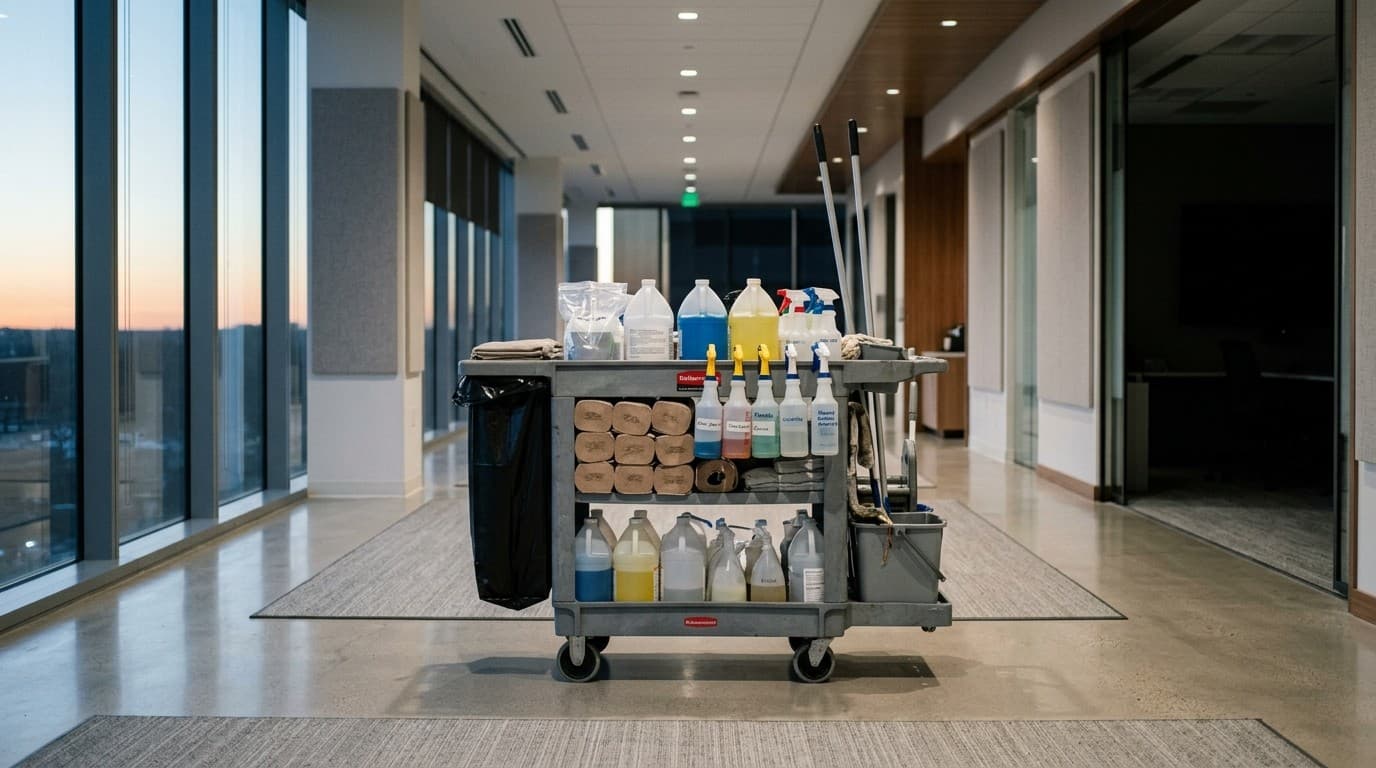
Yes, and this is the part almost nobody argues about. A reputable commercial cleaning company arrives with its own chemicals, its own vacuums, and its own machines, and the cost of all of it is built into the service fee. There is a practical reason and a liability reason. The practical one is that the crew is trained on specific products and dilution ratios, and swapping in whatever is under your sink defeats the point of hiring professionals. The liability one is that the company is responsible for how those products are used on your floors and surfaces, so they insist on controlling what comes through the door.
What "chemicals and equipment" covers on a normal account:
- Disinfectants, glass and stainless cleaners, degreasers, and neutral floor cleaner
- Floor finish, stripper, and the pads and machines that apply them
- Vacuums, mops, buckets, microfiber, and dusting tools
- Auto-scrubbers, burnishers, and extractors for larger buildings
- Personal protective equipment for the crew
You should never see a separate line billing you for the crew's disinfectant or their vacuum bags. If you do, question it. The only common exception is a specialty product you specifically request, such as a particular green-certified line or a fragrance-free chemistry for a sensitive tenant, which a company may pass through at cost. Our approach to green and eco-friendly cleaning products works this way when a building asks for it, and it is stated up front rather than discovered on an invoice.
What Are Consumables, and Why Are They Billed Separately?
Consumables are the products your occupants use up between cleaning visits, and they are billed separately because their cost is driven by your building, not by the cleaning. A crew uses roughly the same amount of disinfectant whether your restroom sees 20 people a day or 200. But a 200-person floor burns through paper towels, toilet paper, and hand soap at ten times the rate, so folding that into a flat cleaning fee would mean either overcharging the quiet building or undercharging the busy one. Separating consumables is how the number stays honest.
The consumables that show up on nearly every commercial account:
- Toilet paper and multifold or roll paper towels
- Hand soap and, increasingly, hand sanitizer
- Trash can liners in every size the building uses
- Toilet seat covers, air fresheners, and feminine hygiene products where applicable
Two things make this category slippery. First, consumption is invisible until it fails, so nobody thinks about paper towels until a dispenser is empty during a client visit. Second, "supplies" is a word that sounds like it covers everything, which is why a vague "supplies included" line does so much quiet damage. It can mean the chemicals the crew was always going to bring, and nothing about your paper and soap at all.
How Do New Jersey Cleaning Contracts Bill for Consumables?
There are three legitimate structures, and the right one depends on how much control you want versus how little you want to think about it. Here they are side by side.
| Billing structure | How it works | Best when | Watch for | |---|---|---|---| | Included / bundled | A flat monthly consumables allowance is folded into the service fee against a stated dispenser count | You want one predictable number and no reorder calendar | An allowance with no dispenser count or no restocking standard | | Cost-plus / pass-through | The company buys the consumables and itemizes them on the invoice, sometimes with a small handling markup | You want to pay actual usage and see it | An undisclosed markup, or no itemization to check against | | Client-supplied | You buy and stock everything; the crew refills dispensers from your closet | You want full control of brand and grade | You own the reorder calendar, and a stockout is on you |
None of these is a trap on its own. Bundled is the most hands-off. Cost-plus is the most transparent about actual usage. Client-supplied gives you the tightest control over brand and grade, which matters for buildings that have standardized on a specific product or need a particular soap for a medical or food environment. What turns any of them into a problem is leaving the structure unwritten, so each party quietly assumes a different one.
How Much Do Consumables Actually Add to the Bill?
When consumables are passed through rather than client-supplied, they commonly run in the range of 5 to 12 percent of the monthly service fee for a typical office, and they climb from there for buildings with heavy public restroom traffic like retail storefronts, medical suites, or anywhere with a steady stream of visitors rather than a fixed headcount. That is not a rounding error, and it is not constant from building to building, which is the entire reason it deserves its own line.
This is also where the two-quote confusion resolves. Picture a 15,000-square-foot office getting two bids:
- Bid A quotes the cleaning and adds a named consumables allowance for restroom and break-room supplies across a stated dispenser count.
- Bid B quotes a lower single number and says "supplies included" once, with no detail.
Bid B looks cheaper until you ask what "supplies" means. If it means only the crew's chemicals, you are about to inherit the paper and soap yourself, and the real cost of Bid B is its number plus your consumables spend plus the hours someone on your team now spends reordering. Once you add that back, the gap often closes or flips. The point is not that bundled is better than client-supplied. It is that you cannot compare two bids until both of them state the same thing about supplies. Our commercial cleaning pricing guide and our breakdown of office cleaning cost per square foot both treat consumables as a separate line for exactly this reason.
What Should the Supply Line in Your Contract Actually Say?
A complete supply line answers four questions: who supplies each category, how it is billed, how many dispensers are covered, and what standard triggers a refill. Miss any one of them and you have left room for the gap to reopen later. A line that does the job reads something like this:
Contractor supplies and restocks paper towels, toilet paper, hand soap, and can liners across 12 restroom dispensers and 3 break-room stations, billed as a flat monthly allowance, restocked to full on each visit.
Every element there is doing work. Naming the categories closes the "supplies" ambiguity. Naming the billing structure sets expectations for the invoice. The dispenser count turns the allowance into something checkable, because an allowance with no count is a number with nothing behind it. And the restocking standard, "restocked to full on each visit" or "refilled before reaching empty," is what keeps a dispenser from running dry between refills. A refill standard that triggers on empty means somebody always finds it empty first.
A quick checklist to run against any proposal before you sign:
- Does it name each consumable category, or just say "supplies"?
- Does it state the billing structure, bundled, cost-plus, or client-supplied?
- Does it give a dispenser or fixture count the allowance is measured against?
- Does it set a restocking standard, so refills happen on a schedule, not on complaints?
- If cost-plus, does it disclose any handling markup?
What If a Quote Does Not Mention Supplies at All?
Treat silence as the answer "you supply everything," and then decide whether that is what you want. A quote that never mentions consumables is not automatically dishonest. Plenty of good companies default to client-supplied because plenty of buildings prefer it. The mistake is reading the silence as "included." Ask one direct question: "Does your price include restroom and break-room consumables, and if so, across how many dispensers?" The answer sorts a real vendor from a vague one immediately. A company that runs recurring accounts will answer with a structure and a number. A company that answers "yeah, supplies are included" and cannot say which supplies or how many dispensers has just told you the line will be a problem.
This is the same discipline that runs through a whole cleaning agreement: the price tells you what you will pay, and the clauses tell you what happens the first time reality does not match the proposal. Supplies are simply the clause that fails first and most visibly, because an empty dispenser is public. If you want to see how the rest of the document should be built, our guide to what belongs in an office cleaning contract covers scope, insurance, and cure periods, and how to choose a commercial cleaning company in NJ walks the vendor-selection step before you get to a contract at all.
If you are comparing bids right now and cannot tell which one includes your paper and soap, that is the question to settle before the number. Contact C&S Commercial Cleaning for a walkthrough quote that states the supply structure in writing, dispenser count and restocking standard included, so the bid you are holding is one you can actually compare.
Frequently asked questions
Does a commercial cleaning company provide its own supplies?
Almost always for chemicals and equipment, and only sometimes for consumables. Every reputable cleaning company brings its own cleaning chemicals, vacuums, mops, and machines as part of the service, because they are trained on those products and liable for how they are used. Consumables that get used up by your occupants, meaning paper towels, toilet paper, hand soap, and can liners, are a separate question the contract has to answer by name. If the proposal does not say who supplies and restocks consumables, assume it is you, and confirm it in writing before you sign.
What is the difference between cleaning chemicals and consumables?
Chemicals and equipment are what the crew uses to do the work: disinfectant, glass cleaner, floor finish, vacuums, auto-scrubbers, microfiber. They belong to the cleaning company and get folded into the service fee. Consumables are what your occupants use up between visits: toilet paper, paper towels, hand soap, trash liners, and sometimes air fresheners and feminine products. The split matters because chemicals are almost never a line you pay for separately, and consumables almost always are, one way or another.
How are cleaning consumables usually billed in New Jersey?
Three ways. Included or bundled, where a flat monthly consumables allowance is folded into the service fee against a stated dispenser count. Cost-plus or pass-through, where the company buys the products and itemizes them on the invoice, often with a small handling markup. Or client-supplied, where you buy and stock everything and the crew simply refills the dispensers. Each is legitimate. The problem is a vague 'supplies included' line with no dispenser count and no restocking standard, which is the one a facility manager only notices is missing when a restroom runs out on a Tuesday.
Roughly how much do consumables add to a commercial cleaning bill?
When they are passed through, restroom and break-room consumables commonly run in the range of 5 to 12 percent of the monthly service fee for a typical office, and higher for buildings with heavy public restroom traffic like retail or medical. It is not a rounding error, and it is not the same building to building, which is exactly why it deserves its own line rather than being buried in a single quoted number. Two bids that look far apart on price often converge once you find the consumables line on one and its absence on the other.
Who supplies toilet paper and hand soap, the building or the cleaner?
Either can, but the contract has to name which one and how the cost appears. If you want the cleaning company to own it, ask for a bundled allowance with a stated dispenser count and a restocking threshold, so a dispenser is refilled before it hits empty, not after. If you supply it yourself, you keep control of brand and grade but you own the reorder calendar, and a missed order is your problem, not the vendor's. The worst outcome is each side assuming the other has it.
What should a supply line item say before I sign a cleaning contract?
It should name who supplies each consumable category, how the cost is billed, how many dispensers are covered, and the restocking standard that triggers a refill. A complete line reads something like: 'Contractor supplies and restocks paper towels, toilet paper, hand soap, and can liners across 12 restroom dispensers and 3 break-room stations, billed as a flat monthly allowance, restocked to full each visit.' If the proposal cannot answer those four questions, it is a price and a start date, not a supply agreement.
Need a Professional Opinion?
Get a complimentary onsite assessment of your commercial space in New Jersey.
Request Consultation